- Meyka AI's Newsletter
- Posts
- Four-Force Pressure: Oil Risks, US-Iran Tensions, AI Earnings, and Jobs Stability
Four-Force Pressure: Oil Risks, US-Iran Tensions, AI Earnings, and Jobs Stability

The market has been through a lot this year. This week added four more things to that list.
Why does the UAE's walking out of OPEC change the oil supply permanently?
What did the Exxon CEO say that the headlines completely ignored?
The gap between Brent at $114 and energy stocks tells one story
What does Nvidia need to prove on May 20?
The quiet job crisis AI is creating for young workers
Oil has no floor. AI has no verdict. And there's a war with no end in sight. The market has to price all three at once.
Market Mood Snapshot
Markets are not panicking, and that tension is worth understanding. Brent crude swung between $110 and $114 this week after peaking at $126 in March, when the Strait of Hormuz closure triggered what the IEA called the largest supply disruption in the history of the global oil market. Twenty percent of the world's seaborne oil flows through that corridor.
Meanwhile, the Nasdaq is trading near its highs, pricing AI infrastructure spend as if geopolitics is a background variable. Four forces are pressing simultaneously and pulling in opposite directions. Understanding how they connect matters more than tracking each one in isolation.
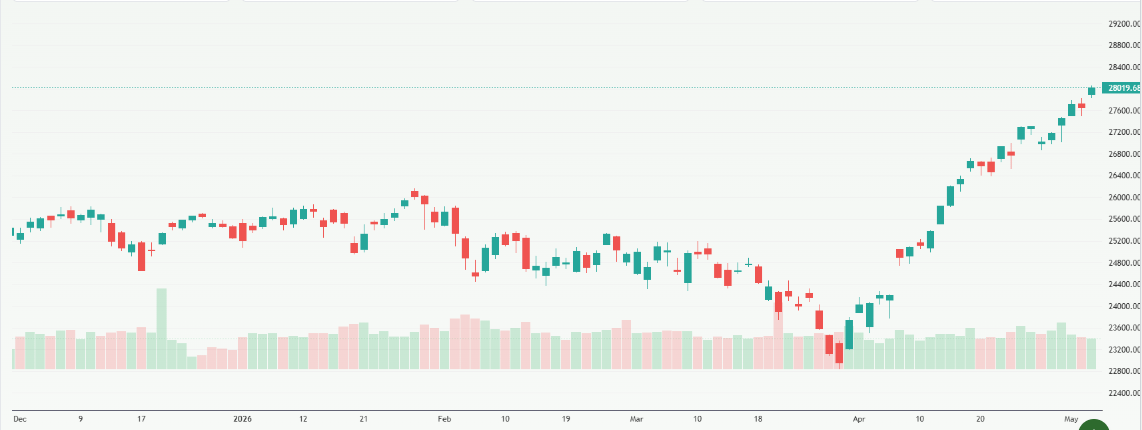
Meyka AI: NASDAQ 100 (^NDX) Index Overview, January 2026 - May 2026
2-Minute Weekly Brief 📜
A Lot Happened, Here Is What Mattered
Three things that defined this week.
Oil prices - Brent swung between $110 and $114 this week, jumping 5.8% on Monday before pulling back on ceasefire signals. Trump launched Project Freedom to guide ships through Hormuz. Only four vessels crossed. Before the war, over 120 ships made that journey daily.
NVDA earnings - Nvidia reports May 20. Analysts project EPS of $1.76 versus $0.89 a year ago. Hyperscalers confirmed sustained data center spending in their own recent results, which sets a high bar for Nvidia's forward guidance.
War impact - Iran struck the UAE's Fujairah oil hub on May 4, which wounded three workers and forced UAE schools and universities to close until May 8. The UAE intercepted 15 missiles and four drones in a single day. Chevron's CEO warned publicly that fuel shortages are becoming a real concern in some regions.
➤ Join Live Market News and Daily Signals 👇️
Money Minute 💡
Spare Capacity
When OPEC holds back oil it could produce, that unused amount is called spare capacity. It acts as a safety cushion for the world.
When supply is disrupted, spare capacity steps in to stabilize prices. The UAE just left OPEC, taking 1.6 million barrels per day of that cushion with it. Less cushion means higher price swings when something goes wrong.
Takeaway: Smaller spare capacity equals bigger oil price shocks.
Noise vs Signal: Ignore the $200 Crowd
Noise
Oil ‘should be at $200’ headlines are not useful. About 11% of crude futures open interest is held by speculative traders betting on a fast US exit from the Iran conflict. That bet is keeping a lid on prices, not physical supply. Prices are moving on political probability, not barrels.
Signal
Exxon CEO Darren Woods told investors in early May: ‘There is more to come if the strait remains closed.’ That is a supply-side warning from the company with the most to gain from higher prices and the most reason to be precise about it.
What Most Missed?
AI is suppressing hiring, not just destroying jobs
Goldman Sachs estimates AI is eliminating roughly 16,000 US jobs per month. The alarming part isn't mass firings. It's that entry-level hiring has quietly stopped.
Workers aged 22 to 25 in AI-exposed roles have seen a 13% employment decline since 2022. Not fired. Just never hired.
For Nvidia, that's actually good news. Enterprises are buying AI infrastructure to compress hiring budgets and extend existing worker output.
One Chart, One Story

Brent is up 78% for the year. Energy equities have significantly underperformed that move. Institutional investors are pricing in crude mean reversion, not $108 sustained through year-end. That gap between commodity price and equity valuation has to close in one direction.
If the Hormuz disruption persists into June, energy stocks re-rate higher. If the war resolves, crude falls back toward $80. Exxon's CEO's language suggests physical markets will force the repricing before the futures market acknowledges it.
Opportunity Lens
Three directional themes worth watching.
First, US shale producers with Permian exposure, including Exxon and Chevron, benefit directly from a structurally smaller OPEC spare capacity after the UAE exit.
Second, Nvidia's earnings on May 20 will confirm whether Jensen Huang's claim of seeing $1 trillion in purchase orders through 2027 is converting to real revenue. Wall Street already prices in 79% growth, meaning Nvidia needs to deliver above 80% for the stock to move meaningfully higher.

Third, Goldman Sachs projects that if AI displacement accelerates faster than expected, the Fed may cut rates earlier than the base case. Investors watching rate-sensitive assets should keep that condition in the model.
Investor Mind Gym
Your Brain Is Overpricing the War
The availability heuristic is working against you right now.
When something is dramatic and repeated in the news cycle, the brain treats it as more probable than data that support it. This is the availability heuristic.
The Iran war has generated more financial coverage in three months than most years produce in total. Investors consuming heavy media are likely to be overweighing disruption risk. Equity markets have recovered.
Corporate earnings have largely held. The oil disruption is real, but the recession scenario that the March headlines projected has not materialized.
The question is not whether these forces matter. They do. The question is whether your portfolio sizing reflects the data or the noise.
Ask Meyka: Which Force Do You Actually Understand 🧐
Two of the four forces are pointing in opposite directions.
Oil pressure raises inflation risk and compresses technology valuations. AI earnings strength pulls them higher. Both can dominate simultaneously for a long time. One resolves first and defines the second half of 2026.
The investors who navigate this well will not be the ones who predicted every move. They will be the ones who know which forces required a response and which ones only required attention.
➤ Not sure how these forces affect your portfolio?
Until next week.
The Meyka Team
Disclaimer:
The content shared by Meyka AI PTY LTD is solely for research and informational purposes. Meyka is not a financial advisory service, and the information provided should not be considered investment or trading advice.